JUAL

JUAL Think Tank | Say No to "Full of Holes"! Analysis of Non - perforated Electromagnetic Induction Welding Technology
(JUAL Roofing Technology(苏州)有限公司,江苏苏州,215000)
摘 要:
关键词:Non-penetrating Electromagnetic Induction Welding; Roof Waterproofing; Law of Electromagnetic Induction; Waterproof Membrane Fixation; Wind Uplift Resistance; Construction Efficiency; Non-penetrating Process
01. What is Electromagnetic Induction Welding?
Electromagnetic induction may sound unfamiliar to many, yet it has long been widely applied in automobile manufacturing, aerospace engineering, and even daily household appliances such as induction cookers.
It is based on the renowned Faraday's Law of Electromagnetic Induction. Simply put: when high-frequency alternating current passes through a coil, an invisible alternating magnetic field is generated. When metal is placed within this magnetic field, eddy currents are produced inside the metal, causing it to heat up rapidly.
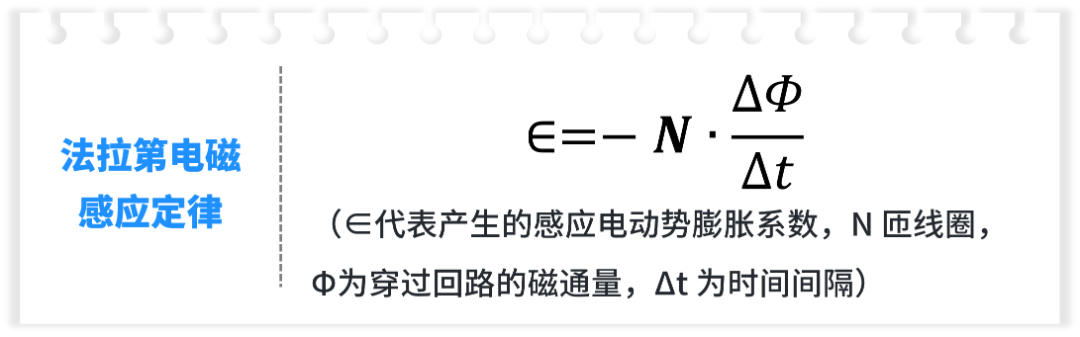
The magic of this technology lies in its ability to heat metal remotely without open flames or physical contact.
02. Working Principle of Non-Penetrating Electromagnetic Induction Welding
This fundamental physical law has been ingeniously applied to the building waterproofing industry. In traditional roof construction, waterproofing membranes are usually fixed by drilling and nailing — just like poking holes in an intact raincoat.
To solve this pain point, the non-penetrating electromagnetic induction welding process was developed. Based on Faraday’s Law of Electromagnetic Induction and Joule-Lenz Law, it achieves non-penetrating and high-strength fixation through targeted magnetic conduction heating and interface fusion bonding.
It is like performing a non-invasive surgery on the roof, firmly fixing the waterproofing membrane without damaging the waterproof layer.
The working mechanism can be summarized in three simple steps:
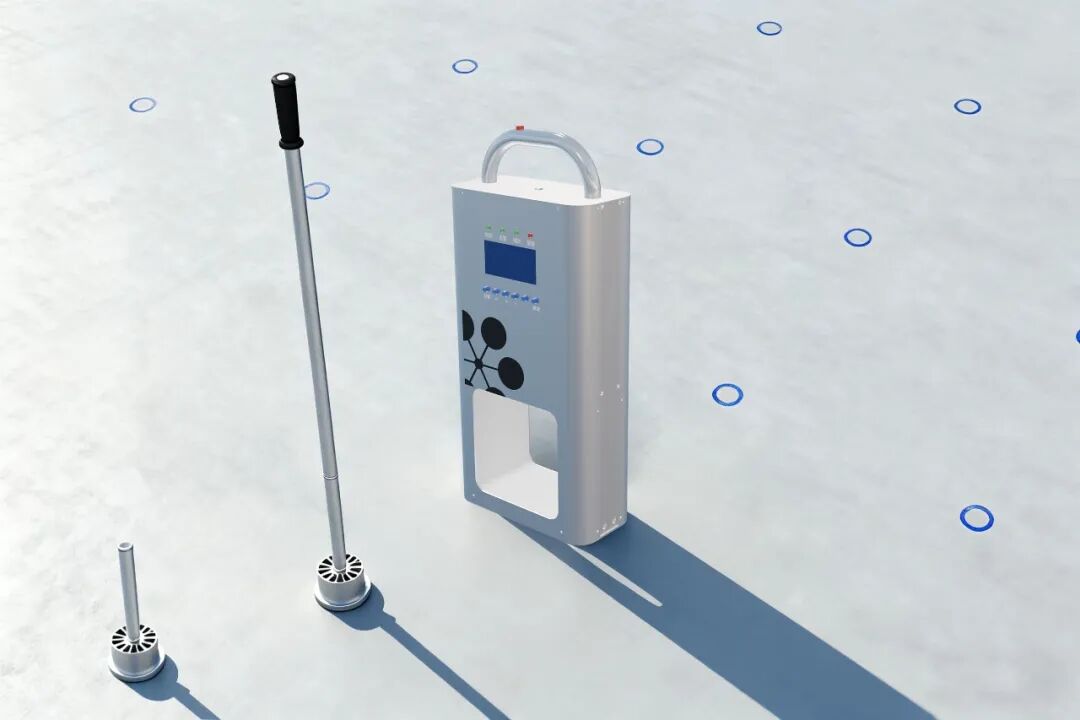
★ Remote Heating: Place the electromagnetic welding machine above the membrane. The equipment generates a high-frequency magnetic field that penetrates the membrane and instantly heats the underlying metal gasket.
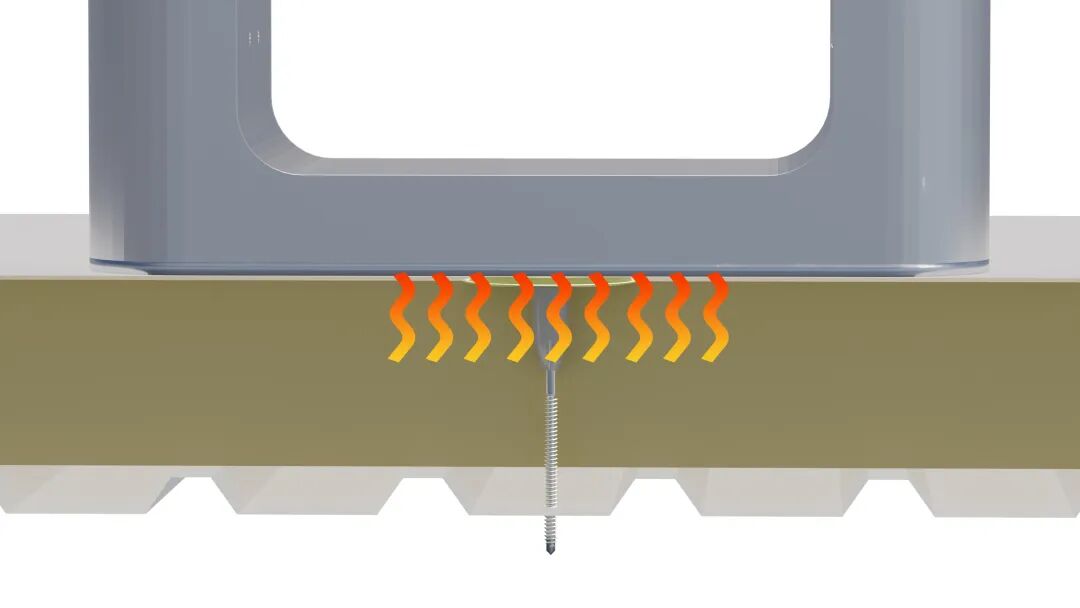
★ Interface Fusion: Heat from the gasket melts the special coating on the gasket surface and the bottom of the membrane, without damaging the main body of the waterproof membrane.
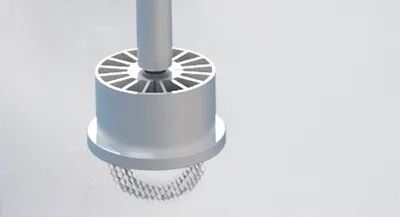
★ Pressure Bonding: After moving the welder away, immediate pressure is applied to tightly bond the melted materials. Once cooled, the membrane and gasket integrate into an inseparable whole.
03. Traditional Mechanical Fixation vs Non-Penetrating Induction Welding
A. Waterproof Performance: From Hidden Leakage Risks to Completely Leak-Proof
❌ Traditional Mechanical Fixation
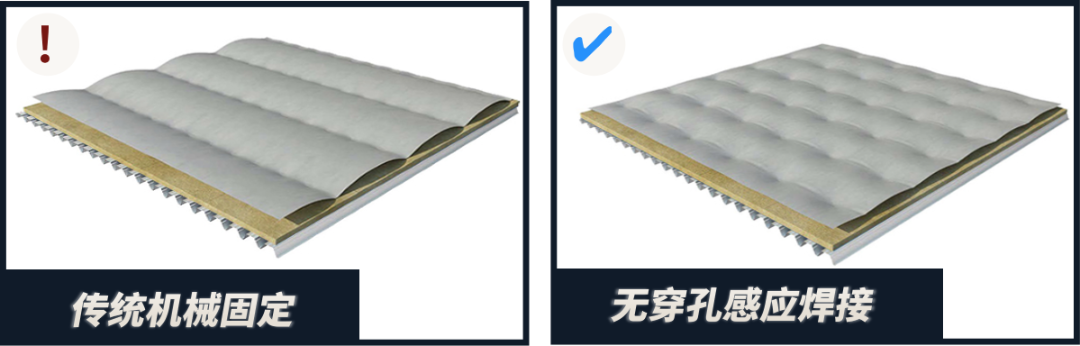
Fasteners penetrate the main waterproof membrane, creating stress concentration points that easily cause membrane tearing, damage and accelerated aging, directly compromising the integrity of the waterproof system.
✅ Non-Penetrating Induction Welding
Zero penetration. The waterproof membrane maintains 100% integrity, eliminating penetration leakage paths at the source.
B. Wind Resistance: From Single-Point Force Bearing to Full-Surface Wind Resistance
❌ Traditional Mechanical Fixation
Fixed only at single points along overlapping edges. Under strong winds, the roof undergoes periodic wind vibration, leading to fastener loosening, pull-out or gasket failure, and greatly shortening the overall service life of the roof.
✅ Non-Penetrating Induction Welding
Upgraded from traditional single-point fastener stress to uniform force distribution over the entire welding area. Tested in accordance with FM standards, the system’s wind uplift resistance is improved by 30%–50%.
C. Construction Efficiency
❌ Traditional Mechanical Fixation
Manual laying and on-site fixing. Fastener spacing, compression force and flatness are difficult to standardize. It requires a large number of fixing points and relies on skilled workers with hand tools for point-by-point installation. High labor intensity and shortage of skilled workers make it hard to meet the rapid delivery demands of large-scale roof projects.
✅ Non-Penetrating Induction Welding
A single welding point takes only about 5 seconds. The highly automated equipment greatly reduces labor intensity and avoids uneven installation caused by human error.