JUAL

JUAL Think Tank | The Significance of Mechanical Anchorage Connections for Single - ply Roofs
(JUAL Roofing Technology(苏州)有限公司,江苏苏州,215000)
摘 要:
关键词:
In recent years, the application proportion of single - ply roofs in the commercial and industrial building sectors has been continuously rising. New projects such as logistics and warehousing centers, light - industrial factories, and shopping mall complexes commonly adopt the combination of lightweight profiled steel sheets and single - ply waterproof systems. This not only enables rapid construction and efficient thermal insulation but also reduces the structural construction cost. However, with the diversification of functional requirements, more and more equipment and systems are directly installed on the roof. The roof is no longer just "the hat of the building" but an important platform that bears production and management functions.

This trend brings a core challenge: how to safely, stably, and economically fix the newly added equipment to the single - ply roof without affecting its waterproof function, safety, and durability. Against this backdrop, mechanical anchorage connection technology has emerged and is becoming a key solution in the field of single - ply roof installation.
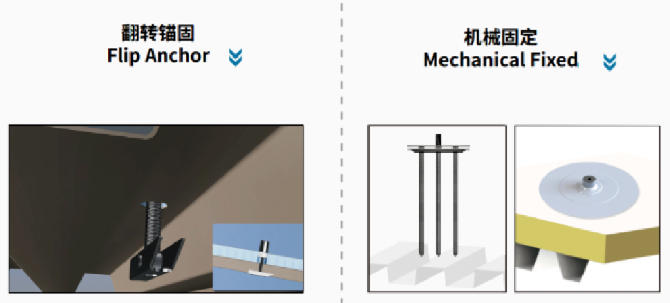
Mechanical anchorage is to directly connect the additional roof equipment (such as photovoltaic brackets, machine - room equipment, ventilation systems, etc.) to the main load - bearing structure of the building, usually profiled steel sheets or purlins, through engineered structural components, bolts, or special fixtures. Different from merely staying on the surface of the roof waterproof layer or insulation layer, mechanical anchorage is equivalent to extending the load of the equipment from the "surface layer" to the "skeleton", achieving the integration of the force - bearing with the original building structure system.
The core of this connection method lies in "taking root". The so - called "root - based connection" is to make various loads such as upward uplift force, downward pressure, and horizontal shear force be transmitted along the force - bearing design path of the original structure by expanding the contact surface and optimizing the force - bearing path, forming a stable mechanical whole. The mechanical anchorages make the load transfer along the path of profiled steel sheet → purlin → main beam → steel column, avoiding the formation of local concentrated stress within the waterproof layer or insulation layer and fundamentally protecting the integrity and long - term performance of the roof system.
A. Limitations of Non - mechanical Anchorage
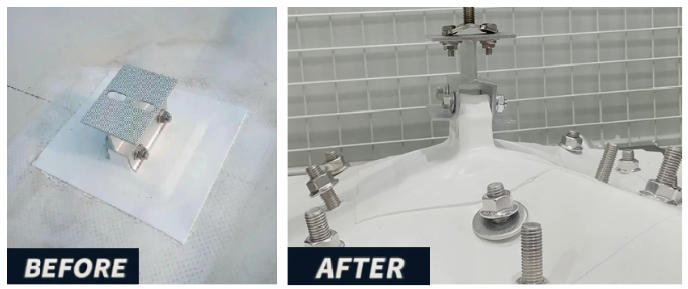
• Chemical Connection (Adhesive Welding Fixation): It relies on adhesives, sealants, or hot - air welding to bond and fix the equipment base to the roof surface layer. It is convenient for construction and does not require penetrating the roof. However, the bonding layer will age due to the influence of ultraviolet rays, temperature and humidity changes, and stress pulling. The bonding force decays significantly during use, the stability of load transfer is insufficient, and it is prone to failure in extreme weather.
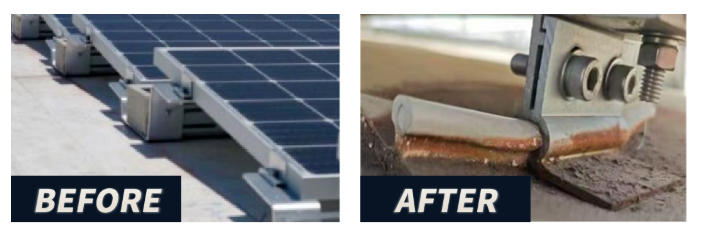
• Physical Ballast (Heavy - weight Fixation): It counteracts the wind load by increasing the ballast mass such as concrete blocks and metal weights. However, the ballast will significantly increase the static load on the roof, reducing the structural load - bearing margin. And under local heavy pressure, it may cause the waterproof layer to sag, accumulate water, or even leak. The wind suction force cannot be quantitatively offset, and there are risks.
B. Breakthrough Advantages of Mechanical Anchorage
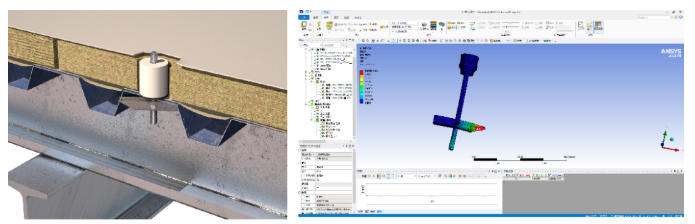
• Quantifiable Calculation: Compared with chemical connection and physical ballast methods, the advantages of mechanical anchorage not only lie in the convenience of construction but also in the scientific nature of its structural mechanics and the stability of long - term use. First, in the design stage before installation, the tensile performance of mechanical anchorage can be quantitatively analyzed and precisely designed through structural calculations and industry - authoritative software. Designers can simulate various wind loads, snow loads, and other extreme external action conditions in the model and directly compare the results with the building structure safety factor.
• Stable Support and Tensile Performance: Second, the force - bearing path of mechanical anchorage is clear and stable. Different from ballast or adhesive bonding methods, mechanical anchorage directly transfers the load to the load - bearing steel structure of the roof through metal connectors, forming a force - bearing system consistent with the original design. Whether it is the vertical downward pressure or the upward uplift force generated by wind suction, it can be stably unloaded along the path of profiled steel sheet - purlin - main beam - main frame, avoiding the formation of local concentrated stress in the waterproof layer or insulation layer, thus preventing it from failing prematurely due to long - term fatigue or deformation.
• Safety and Durability: Mechanical anchorage uses high - strength and corrosion - resistant metal materials, which can effectively resist the influence of extreme environments such as heat and humidity, freeze - thaw, acid - base, and chemical erosion. Since the connection strength does not depend on the performance decay of the adhesive, the long - term stability of mechanical anchorage is consistent with the lifespan of the building main body. Even in a 25 - year usage cycle, it can still maintain the original designed tensile level.
C. Advantageous Features of Mechanical Anchorage
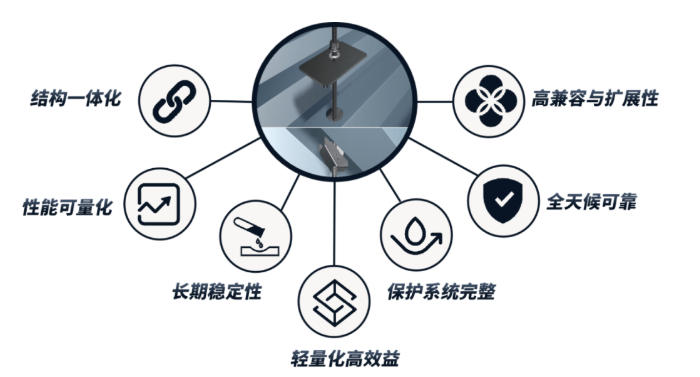
Structural Integration: The load directly reaches the main load - bearing structure, forming a unified force - bearing system with the original building instead of staying on the surface layer.
Quantifiable Performance: All mechanical properties can be accurately calculated, designed, and verified, with clear safety boundaries.
Long - term Stability: Using corrosion - resistant metal materials, the performance has the same lifespan as the building, without the risk of aging and decay.
Light - weight and High - efficiency: Avoiding the huge static load brought by ballast, it optimizes the structural economy of the building.
Protection of System Integrity: Professional waterproof design ensures that the anchorage points are reliably sealed without damaging the overall waterproof performance of the roof.
All - weather Reliability: It can still provide a stable and reliable connection under extreme weather conditions such as typhoons and heavy snow.
High Compatibility and Expandability: It is applicable to various single - ply roof systems and provides standard interfaces for future equipment installation.

Today, with the increasing integration of building functions, the significance of JUAL single - ply roof mechanical anchorage connections has long exceeded that of a simple fixing technology. It profoundly responds to the core demands of single - ply roof buildings for safety, economy, and sustainable development, activating the roof from a passive "protective layer" into an active "value - creating platform". It can be foreseen that with the improvement of industry standards and the deepening of market awareness, mechanical anchorage will surely become the standard configuration of high - quality single - ply roof systems.