JUAL

JUAL Think Tank | After the Torrential Rain, Is Your Roof Really Okay? Eradicate the Stubborn
(JUAL Roofing Technology(苏州)有限公司,江苏苏州,215000)
摘 要:
关键词:
Recently, Beijing has encountered a rarely - seen heavy rainfall in history. With the red alert in place, the whole city was on high alert. While we focus on the obvious disasters such as urban waterlogging and traffic paralysis, a "battlefield" that is often overlooked - the building roof, especially the flat roof, is also undergoing a severe test. For single - ply roofing systems, "ponding" is a more hidden and long - term destructive "invisible killer" than "leakage".
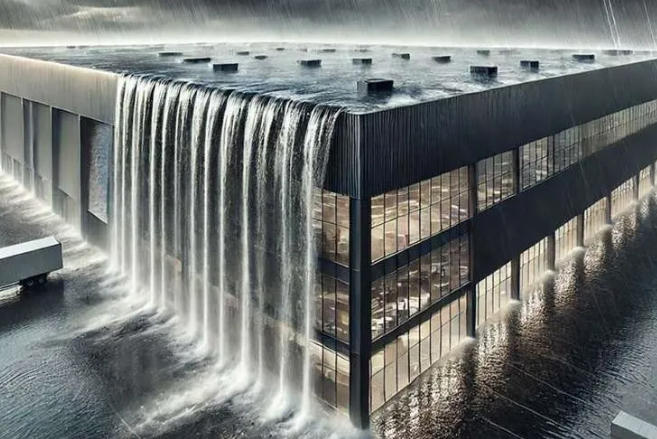
High - quality single - ply waterproof membranes (such as TPO, PVC, EPDM) themselves have excellent water - repellency and durability. Prolonged immersion in water will not fundamentally damage their material properties, and the warranties of most manufacturers will not be invalidated as a result. However, this is precisely the crux of the problem. Precisely because of the "robustness" of the membrane, a more destructive risk is concealed - the structural threat of ponding to the entire roofing system.
At the beginning of the design of the flat - roof structure of a single - ply roofing system, its load calculation is based on the core premise of "smooth drainage". Engineers consider wind, snow, and load, but usually do not include the weight of large - area and long - term ponding. Water is heavy, with 1 cubic meter of water weighing 1 ton. For a 100 - square - meter roof, if the average depth of ponding is only 5 centimeters, it means an additional load of exactly 5 tons! This is equivalent to parking 3 - 4 cars on the roof.
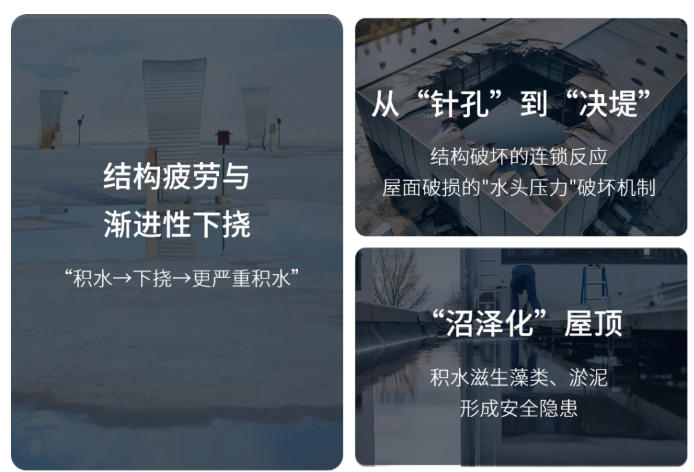
This "unplanned" continuous heavy pressure will bring about a series of chain reactions:
-
Structural Fatigue and Progressive Deflection: The continuous heavy pressure of ponding will increase the ponding, forming a vicious cycle of "ponding → deflection → more serious ponding" until the structure fails.
-
From "Pinhole" to "Breach": No roof can guarantee 100% protection from external forces. In the ponding area, a tiny breakage point, under the action of "water head pressure", will continuously and rapidly "inject" water into the building interior, causing far - exceeding - expected damage.
-
"Swamp - like" Roof: Ponding not only breeds algae and silt, creating safety hazards, but the freeze - thaw cycle in winter is also a continuous battering of weak points such as membrane joints and equipment bases.
And the root cause of all these risks points to one core - poor drainage.
The heavy rain is just "the last straw that breaks the camel's back". The root cause of ponding lies in the flaws in the design and construction of the roof drainage system. The following are several typical "severely - affected areas":
● Slope: The bottom line of 1:80
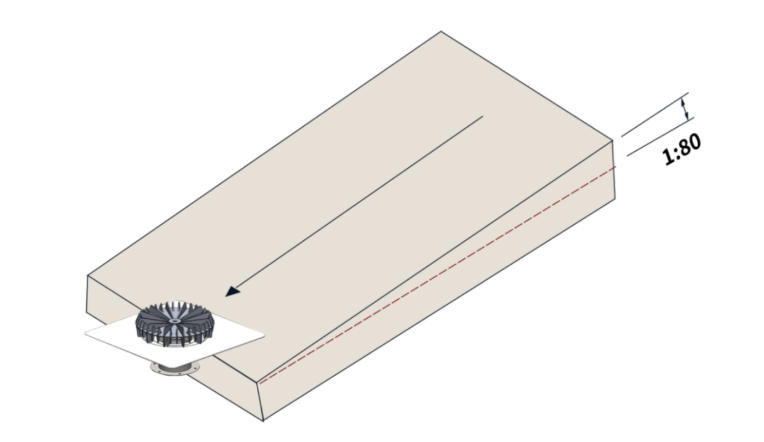
Although a single - ply roof may seem flat, it must have a slope. According to GB55030 - 2022 "General Code for Waterproofing of Building and Municipal Engineering", the roof drainage slope should be ≥ 2%. Considering construction errors and structural deformation, the final built - in slope must not be less than 1:80 (1.25%). Below this bottom line, ponding is almost inevitable.
● Details: The threat of dead - end ponding
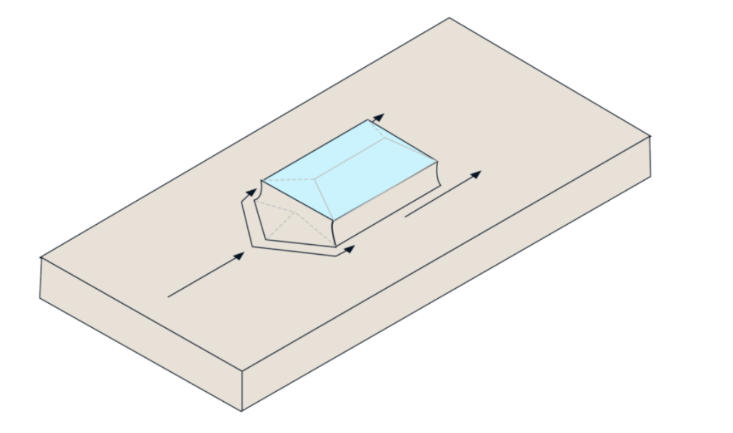
When the water flow is blocked by structures higher than the roof, if there is no specially designed drain outlet, a "dead - water area" will form behind it. If the drain outlet is set at the highest point of the roof, or if the membrane closure around it is too thick, forming a "protrusion", the water cannot be drained completely.
● Paralysis: Blocked drain outlet
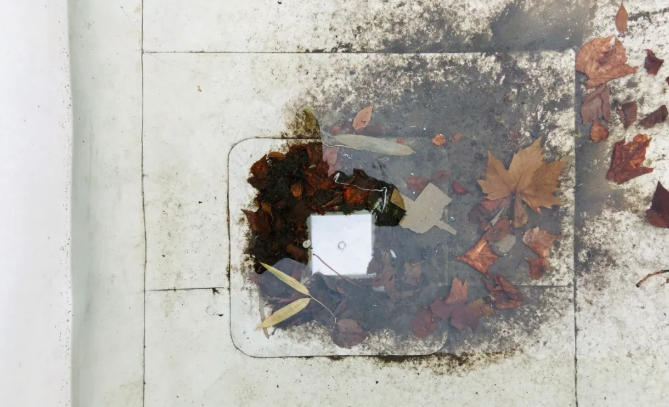
Leaves, garbage, and atmospheric dry and wet deposits are common culprits for blocking drain outlets. A blocked drain outlet is enough to turn the entire zoned roof into a "reservoir". During heavy rain, the capacity of the drainage system quickly reaches its limit. Once there is a blockage, temporary ponding will quickly turn into long - term "waterlogging".
A. Systematic Layout: Double - guarantee for Normal and Extreme Conditions
The gravity - type drain adopts a systematic design of "normal flow + overflow". By reasonably designing and arranging gravity - type drain outlets and lateral overflow outlets on the roof, the catchment area is effectively dispersed. It can not only efficiently handle daily rainfall but also, when a heavy rain comes, activate the overflow system as a second - level safeguard, completely eliminating the risk of the entire roofing system collapsing due to a single - point failure.
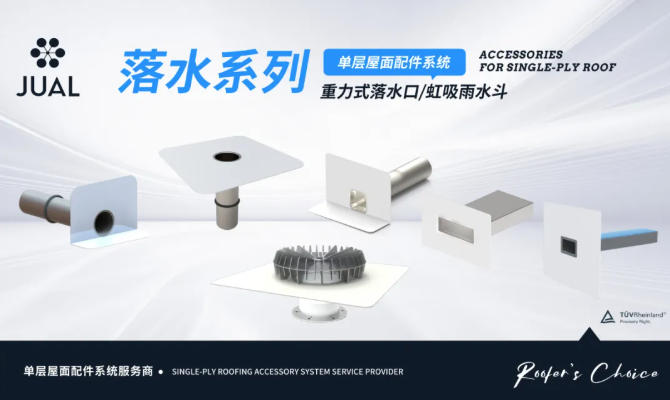
The siphonic rainwater hopper is designed with an anti - vortex device. Before the rainwater flows into the hopper chamber, it becomes evenly dispersed, and the conditions for forming a vortex are destroyed, preventing air from entering, and the system is in a full - pipe flow state. The siphonic rainwater hopper can reach a full - flow state under a relatively small water depth in front of the hopper, effectively reducing the ponding depth of the roof (gutter) and reducing the roof load.
B. Intelligent Defense: A "Breathable" Leaf Guard
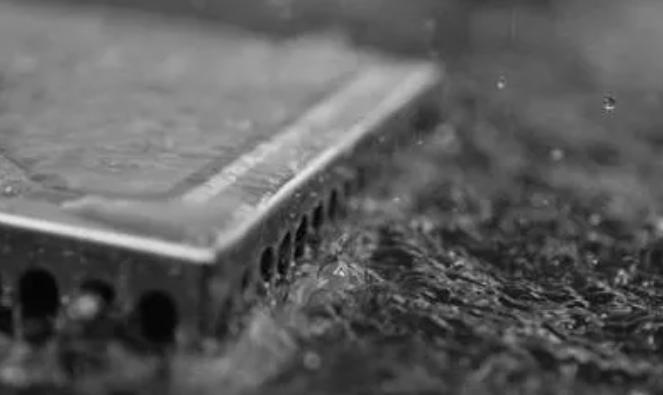
The blocked drain outlet is the number - one cause of ponding. The leaf guard designed by JUAL can not only effectively filter leaves and debris to keep the pipeline unobstructed but also incorporates ingenuity in its design: when the water level rises due to heavy rain, its unique structure can trigger a siphon effect, instantly increasing the drainage speed several times, allowing the roof to return to a safe state in the shortest possible time. This is an intelligent defense mechanism of "becoming stronger when facing a stronger situation".
C. Ending Weak Points: An Indestructible Integrated Connection
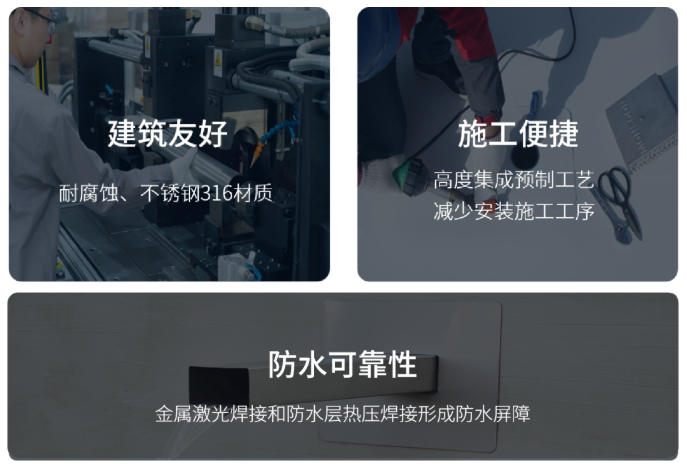
※ Building - friendly: It uses corrosion - resistant, high - quality 316 stainless steel, achieving molecular - level hot - air welding with TPO/PVC waterproof membranes.
※ Convenient Construction: Through a highly integrated pre - fabrication process, the number of installation and construction procedures is reduced, making the construction more convenient and faster. It can be installed by a single person in 5 - 10 minutes.
※ High - strength Performance: The welding strength is as high as 1.0kN/50mm (TPO). According to the national standard (GB27789 - 2011), this value is 8.3 times the peel strength of the waterproof membrane's own joints!
In an era of frequent extreme weather, by reasonably designing and choosing a professional pre - fabricated product supporting solution like the JUAL drainage system, what you will gain is not only excellent drainage performance but also a sense of "certainty" and "peace of mind" in the face of the uncertain climate in the future. It can effectively extend the service life of single - ply roofs, thereby enhancing the durability and safety of the entire building.